"The mental facility to detect conspiracies and betrayal are the same qualities most likely to corrode natural judgment. Everything that seems clear is bent. And everything that seems bent is clear. Trapped in reflections, you must learn to recognize when a lie masquerades as the truth, and then deal with it efficiently, dispassionately."

Edward Wilson (Matt Damon) believes in all that America stands for and will do whatever he must to protect what his country stands for. As one of the founder members of the CIA in 1939, Wilson is also one of the most trusted members of this group of secrecy. When the idea that a mole may be working within the CIA is found, Wilson is told to find out which member is the mole. The path Wilson must take to discover this mole will lead him to question not only the CIA as a group, but also his personal life.

Lurker (2025), written and directed by Alex Russell, presents itself as a subliminal film that examines the toxicity of pop culture through an allegory of parasitism in the emergence of fame. At its core, it leans into themes of parasocial obsession, identity construction, and celebrity as a kind of social system. Rather than relying on spectacle, the film grounds itself in perception and lived experience. This comes through most clearly in its use of diegetic characterization, where elements within the film are not just stylistic choices but extensions of the story itself. One of the more interesting ways it does this is through its soundtrack. The film features a bi-layered original score by Kenny Beats, made up of both non-diegetic music and diegetic tracks performed in-character by Archie Madekwe as the pop star Oliver. At first, the songs can come off a bit corny, but they start to click as the film unfolds. “Sweet Talk” plays into charisma and appeal, “Snakes in the Garden” taps into paranoia within the entourage, “Domicile” reflects in-group dynamics, and “Love and Obsession” leans directly into parasocial tension. By the end, the songs feel less like additions and more like a story running alongside the main narrative, quietly reinforcing what the film is trying to say.

At the center of the film are Matthew (Théodore Pellerin) and Oliver, whose personalities operate in tension rather than opposition. Matthew begins as observant and socially aware, positioning himself as nonchalant when meeting Oliver for the first time. He is performative enough to impress Oliver to invite him to hang out at an upcoming show. As his connection to Oliver grows, that observational stance becomes more coercive and manipulative. He does not simply document the environment but begins to shape it, subtly directing outcomes in ways that secure his position. Oliver, by contrast, embodies a form of charisma that feels effortless yet dependent on those around him. He is magnetic and socially fluent; he is not passive in how he holds power, either. He may come off as effortless, almost whimsical, but there is intention behind who he keeps around and how he lives his life. He chooses his circle, and he is fully capable of exerting control when he wants to. When he decides to distance himself from Matthew, it is deliberate, and it shows just how he controls his life. Consequently, Oliver’s entourage feels less like a group of friends and more like a system where everyone is trying to hold their place. Oliver’s friend, Noah (Daniel Zolghadri), is one of the first places where you can see a shift in dynamics. As Matthew gets closer to Oliver, Noah starts to feel less like a friend and more like something that is being left behind. There is a quiet tension there, not because Matthew initially does anything wrong, but because he begins to see him as a replacement. He immediately views Matthew as a threat and acts with jealousy. That same tension plays out in reverse with his work friend, Jamie (Sunny Suljic), growing closer to Oliver as the movie progresses. Same as with Noah, Matthew views Jamie as a threat and does his best to manipulate their growing connection from happening. Not only were the characterizations rich in the film, but the dynamics between them were constructed in a way that landed the allegory of pop culture as a lived experience perfectly. In this way, you see an engulfment of envy and jealousy as a collective driver for behavior.

"Want some pie?"

Follow me if you can. Somewhere out there in movieland there is a place called Normal that is anything but. And Nobody lives in the town of Normal. Of course, I'm really talking about Bob Odenkirk. He's the actor who had a heart attack filming the last season of his Breaking Bad spin-off Better Call Saul. Now most actors will look at having a heart attack as a sign to slow down. That's not what Odenkirk did. He decided to push himself by training for his first action film for five years with the stunt guys who did a lot of the John Wick action. That film was Nobody with Odenkirk playing the titular "Nobody". The strange thing is that he had a ton of fun and was quite good in the role and ended up in a sequel. Not willing to take "no" for an answer, he is now starring in his third action film, which also happens to begin with the letters n o. This time out is with director Ben Wheatly and co-writer Darek Kolstad. The film is called Normal, and it's a lot more fun than this setup might make you think. It's not going to win any awards, and it's not going to go down as a classic. What it will do is provide 90 fast-paced minutes of pure entertainment, and you know what? I'm OK with that.

“We just did what we're programmed to do. Human or AI. We all make mistakes ... and we learn.” 

This film feels like what would happen if Minority Report and Source Code had a baby. Chris Pratt and Rebecca Ferguson give it their all, and while the film can be exhilarating at times, it wasn’t a mind-blowing experience. The premise is as follows: in the not so distant future (2029 to be exact), Los Angeles establishes Mercy Capital Court in response to a surge in crime using artificial intelligence (AI) judges to try defendants for violent offenses. To assemble evidence, all devices are registered to the municipal cloud to allow the AI judge to pass judgement. The AI judge also gives the defendants all available resources to find and provide all the evidence needed to prove their innocence in 90 minutes or be executed via a sonic blast. Pratt’s character finds himself in that very predicament, facing execution for the alleged murder of his wife. Rounding out the cast is Rebecca Ferguson as the A.I. judge passing judgement, Annabelle Wallis as Pratt’s character’s deceased wife, Kenneth Choi, and Chris Sullivan.

It's Planet Of The Apes meets Cujo, and it sure isn't pretty. Part of me actually loves this kind of thing, but it has more to do with when the film is than how good or bad the film happens to be. For a lot of critics, we have just spent the better part of our last year being inundated by awards bait in one form or another. Everyone wants your attention right then. I have to vote in two guilds, and honestly by the time it's over and I've managed to cram 60-70 films or more into my holiday activities, I'm more than a little burned out. So after that little break as the new year begins, I always welcome those first films that asks nothing more of me than to sit there and soak it in. There aren't going to be any Best Picture nominations here. No one is going to be buzzing about Primate when we start talking Best Actors and Cinematography. Johannes Roberts isn't expecting me to remember a dang thing about his work when next year's Best Director choices come up. The screenplay is (thank God) completely forgettable, and all I will remember, if I remember anything at all about Primate when the 2026 awards season rolls around, is that it was mindless, and that's exactly what I needed after weeks of press screenings. I hope you guys had a blast making the film, because you gave me exactly what I was looking for ... absolutely nothing. And you got me in and out in UNDER 90 minutes. I love you guys, but I'll forget I said that in a few months. Is that OK? This is going to be a really short love affair. It's the perfect one night stand of movies. But that doesn't mean that I really didn't love you guys for 89 minutes. Thus ends the sermon. Can I get an Amen?

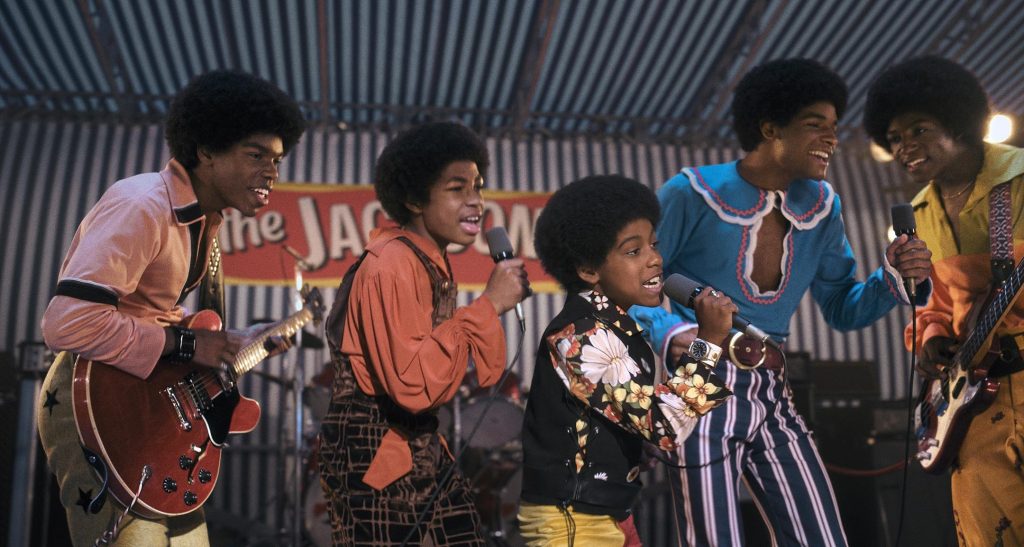
Hears what I remember from a memory already getting a little fuzzy. Fuzzy? Oh, right. There's a chimpanzee named Ben. Perfect name. When I was a kid there was this rat named Ben, and I think he hung out with a young Michael Jackson. That was likely the beginning of the whole Neverland thing. So Ben is the pet chimp of the film's title. Give the folks some credit here. They used a little bit of puppetry and CGI mixed in with some practical makeup f/x, and Ben actually looks pretty lifelike. But the film is always rather dark. Now that could have been a lens issue at our screening. That has been known to happen, or it might have been Roberts using the shadows to get away with more than he might have in the cold light of day. But for the most part, I'll say that watching this chimp go through a rabies infection was more interesting than watching a dog in Cujo. A chimp was actually a pretty brave choice here and added a few points to the film's interest and entertainment value here.

And as if I needed another reason to feel inferior to Rege-Jean Page, he can sing too! This talent was displayed in an impromptu moment in You, Me, and Tuscany, where he provides a rendition of Mario’s Let Me Love You that came as an utter surprise. Naturally, Mr. Page is not the only singing talent in the film, nor would he be the only one to seize an opportunity to showcase that talent. Paired with the live-action embodiment of Ariel herself, Ms. Halle Baily, the two take an old idea and put a new spin on it. You, Me, & Tuscany is an entertaining and enjoyable film that embraces the romance of its location in every possible way. Filmed in Pienza, a town and commune in the province of Siena, Tuscany, in the historical region of Val d'Orcia situated between the towns of Montepulciano and Montalcino, it is considered the "touchstone of Renaissance urbanism". The location is as vibrant as the story, as I found myself admiring the backdrop as much as the story. I’d never given much thought to the idea of visiting Italy, but if it's even half as peaceful and inclusive as the film suggests, I wouldn’t be opposed to booking a ticket.

Bailey plays Anna, a free-spirited, albeit impulsive and rudderless young cook who following a personal tragedy has fallen into the habit of living other people’s lives rather than her making one of her own. This ultimately leads her to make a brash decision to become a squatter in an abandoned Tuscan villa owned by a man she barely knows. What can go wrong? Upon being discovered in the villa by the man’s family, and through her unfathomable decision to put on a engagement ring she found in the house, she is mistaken for the man’s fiancé. This naturally leads to a whole new world of adventure, lies, and love, especially when she meets Michael (Page), the homeowner's cousin.

"Since 2009, special guest contributor Felix Albuerne Jr. has been reviewing new films in theaters for podcasts, terrestrial radio, and TV outlets. In 2023, he launched a YouTube channel and the latest iteration of his review site, "Film Buff Unplugged," on Substack. Subscribe for free at https://fbunplugged.substack.com/ and https://www.youtube.com/@filmbuffunplugged." and follow him on social media here: https://linktr.ee/felixfilmbuff.

The second installment of Nintendo's flagship animated film franchise is a wild ride full of colorful action and more clever nods to classic games, but it's much more for the kids than the first film.

"Trauma is such a powerful force. If untreated it can slither into all the facets of your life, corrupting until finally it transforms you into something you never wanted. That negative energy, it's what that entity feeds off of. I know this is hard for you to hear, but you need to accept the fear that lives in a world that's both seen and unseen, and part of the unseen world detests humanity and wants to see it destroyed, both physically and spiritually. This entity is as ancient as it is evil. Whatever you do, don't let it get you alone in the dark." 

That's actually good advice that applies to movies. They certainly can get us alone in the dark, and sometimes it's a great time. Sometimes maybe not so much. That can be doubly so with an entry in the "found footage" sub-genre of horror films. Sometimes it's a scream. Sometimes it makes you want to scream ... and not in a good way. That's my feeling about Dream Eaters. They say that too many cooks spoil the broth, and when it comes to these dream eaters, that's likely the biggest problem the film has. With three writers/directors who also happen to be the stars of the film? Yeah, it'll make you want to scream.

"Tragic images continue to emerge following the U.S. Military accidental deployment of an experimental weapon off the coast of Tasmania last week, which resulted in the decimation of Hubert and a total loss of life across the island ... Just why news reporters can't go in the disaster zone is still unknown. A clearer understanding of the tragedy has started to take shape. Stretching beyond the fireball at the center of the blast, an electromagnetic pulse resulted in the catastrophic neural failure of all living things on the island, causing their deaths."

Look. It's really hard to make an original zombie movie. Ever since George Romero took the creatures out of the control of Voodoo witchdoctors, there has been a pretty standardized approach to zombies. Of course, everybody thinks they're putting an original spin on an old idea, but most are just regurgitating what's come before with maybe a better makeup job or fancier explanation for how they came to be. It's like putting lipstick on a pig. It's still a pig, and that just makes me hungry. But I think maybe We Bury The Dead from the Outback of Australia from director/writer Zach Hilditch might have made one of the most original moves in the zombie game. They don't really focus on zombies that much, and there are fewer zombies here than in any 20 minutes of a The Walking Dead episode, but what's here is pretty potent.

I’ve watched more than my fair share of horror movies, and I like to believe that I am a fair judge of which ones are good and bad. And it is with that wealth of knowledge that I say that Evil Nun falls into the latter category. And for me this was disappointing, because based on a cover art which has a pretty intimidating picture of a possessed nun, I got my hopes up that I was going to be in for a heart-pumping scare-fest. I know that I’m not supposed to judge a book by its cover, but typically when following that lesson, the moral is not to assume something will be bad based off a first impression. How ironic that I saw the cover and assumed that the film would be good. How very ironic indeed. I won’t go as far as to call the film unwatchable, but I also wouldn’t go so far as to call it horror given that several of the deaths happen off camera. In my experience, for a film to be considered a horror film, death scenes are a pretty important component of the genre.

The film had a fairly decent premise in my opinion: a youth ministry is trapped in a vacant Mexican church by a vengeful ghost. The ghost, being a vengeful nun, attempts to claim her victims based on the seven deadly sins. The seven deadly sins angle was clear to me at first; one couple seemed to embody a lot of lust, especially given that they are part of a youth ministry. As the film goes on, its film appears to move away from this idea, as the group attempts to determine the ghost’s motivation in an effort to escape. Personally, I think this would have worked better if the film employed the red herring technique and had the killings be the result of human action rather than supernatural acts. The building blocks for such a plot twist were there, and for me, this would have been a more compelling approach to the movie.